Wireless Video Transmission for Stadium Broadcasts: Challenges and Solutions
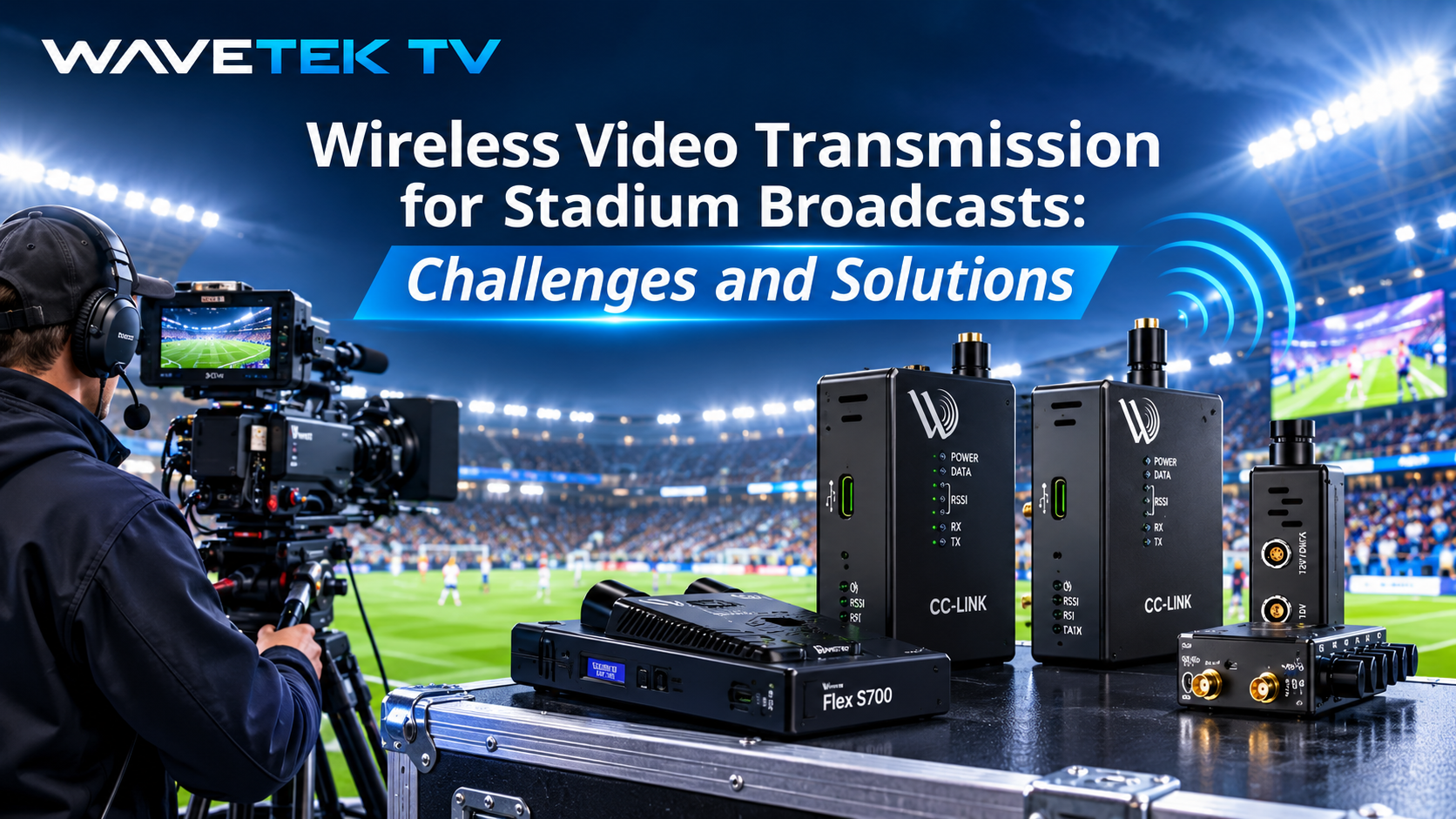
Wireless video transmission for stadium broadcasts means delivering HD video signals from roaming camera positions across a large, RF-congested venue, with sub-1ms latency and the resilience to cope with the spectrum congestion created by tens of thousands of smartphones, competing broadcast networks, and distributed antenna system (DAS) infrastructure all sharing the same airspace. The Wavetek Flex series carries HD video, Sony camera control and IP data over one link, while the CC-LINK series adds wireless camera control at ranges of 1 km to 2 km.
Why Stadiums Are the Hardest Environment for Wireless Broadcast
A stadium at full capacity is, from an RF perspective, one of the most demanding environments a broadcast engineer will ever deploy into. The challenges are not just about distance or power. They are structural, environmental, and operational all at once.
RF Congestion from the Crowd Itself
When 40,000 to 80,000 fans pack into a stadium, they bring their smartphones with them. Every device connected to the venue's Wi-Fi or a cellular DAS network is radiating in the 2.4 GHz and 5 GHz bands. Research into high-density RF environments has demonstrated that human bodies themselves attenuate 2.4 GHz signals, acting as moving obstacles that create shifting signal shadow zones throughout a broadcast window.
Testing at large venues has revealed that tens of thousands of spectators can act as moving signal barriers in the 2.4 GHz band, creating shadow areas that shift continuously throughout an event. For a broadcast wireless link relying solely on 2.4 GHz, this crowd-induced congestion is a live variable that cannot be solved through pre-event planning alone.
Multiple Competing Broadcast Networks
A major stadium event, such as a Premier League match, a rugby international, or a championship boxing card, typically involves multiple broadcast networks operating simultaneously. Each network deploys its own camera systems, each with its own wireless links, all fighting for a finite slice of available spectrum.
At events like major cup finals or international fixtures, broadcast engineers routinely cite frequency and bandwidth allocation as one of the most complex logistical challenges on the production. Pre-event frequency coordination is essential. Engineers must identify and map every wireless system in the venue, agree on frequency allocations, and confirm clearance before broadcast begins, all while working within Ofcom-regulated PMSE spectrum rules.
Structural RF Obstacles: Concrete, Steel and DAS Antennas
Modern stadiums are built from reinforced concrete and steel, materials that absorb and reflect RF signals. Camera positions deep in covered stands, inside player tunnels, in locker room corridors, or beneath the upper tiers of a large venue all present non-line-of-sight (NLOS) challenges that a simple line-of-sight wireless link cannot handle.
The DAS infrastructure installed to serve fans with cellular coverage can itself become a source of interference, as its transmitters operate in bands that overlap with broadcast wireless frequencies. Engineers deploying in covered or partially enclosed positions must account for both the structural attenuation and the active interference from venue infrastructure.
OB Truck Distance from the Action
In a stadium environment, the OB truck is rarely parked beside the pitch. It may be in a car park beneath the stands, in an external compound, or several hundred metres from the nearest camera position. This is a common real-world scenario: an OB truck parked in the basement or external compound of a stadium makes long-range wireless transmission essential rather than optional.
Wireless links that can reliably cover several hundred metres, even through partial obstructions, are the baseline requirement for professional stadium deployment.
Key Technical Challenges Explained
Latency: Why Sub-1ms Matters for Live Production
A wireless video link introducing more than one millisecond of latency is incompatible with professional live multi-camera broadcast.
In a live production, the director cuts between cameras in real time. If a wireless camera link introduces even a few frames of delay relative to the hardwired or fibre-connected cameras on the same production, the audio from a presenter's lips goes out of sync with the picture, which is visible and unacceptable on broadcast. For a live broadcast, it is critical that there is no visible latency in the signal between the camera and the receiver, so that the feed from wireless cameras can be cut with pictures from other live cameras and match perfectly, making synchronisation between lips and sound exact.
Technical benchmark: Sub-1ms wireless latency means the signal delay is shorter than a single video frame at 25fps (40ms). This is the professional broadcast standard for any wireless system expected to be cut-switched live. A wireless camera with higher latency cannot be mixed with wired cameras without visible sync errors.
Systems operating at higher latencies, including some consumer-grade and prosumer wireless video devices, cannot meet this standard and should not be considered for live stadium production.
Frequency Band Selection: 2.4 GHz vs 900 MHz
The choice of operating frequency is one of the most critical decisions in a stadium wireless deployment.
2.4 GHz is part of the ISM (Industrial, Scientific and Medical) band: licence-free, globally available, but shared with Wi-Fi, Bluetooth, ZigBee, and every consumer wireless device in the venue. In a stadium at capacity, 2.4 GHz is a contested resource. It offers adequate range in moderate-density environments but degrades significantly when spectrum becomes congested.
900 MHz operates in a less-crowded part of the spectrum. It offers superior penetration through walls, concrete, and structural obstacles, making it significantly more reliable in NLOS scenarios and congested RF environments. For stadium camera positions in covered stands, tunnels, and sub-stand areas, 900 MHz provides more consistent link reliability than 2.4 GHz under heavy spectator load.
The ideal stadium wireless system offers a choice of bands, allowing engineers to select the optimal one for each camera position, or fall back to 900 MHz when 2.4 GHz becomes congested during the broadcast.
Non-Line-of-Sight Signal Paths Inside Large Venues
Most professional broadcast wireless systems are designed for line-of-sight operation: a clear path between transmitter and receiver. Stadiums routinely break that assumption. Camera positions may be obscured by structural columns, roofing, or the crowd itself.
Systems using COFDM (Coded Orthogonal Frequency Division Multiplexing) modulation are engineered specifically for NLOS broadcast environments, using multipath signal reflections to maintain a robust link even without a direct sightline. For stadium deployments, COFDM-capable systems offer a significant reliability advantage over simpler direct-sequence spread spectrum designs.
Simultaneous Multi-Camera Coordination
A professional stadium broadcast may involve six to twelve wireless camera links operating simultaneously, from pitch-level positions, elevated gantries, behind-the-goal positions, and roving ENG cameras in the crowd. Each link occupies spectrum, and each must be coordinated to avoid co-channel interference.
The practical limit on simultaneous wireless cameras in a shared venue depends on the frequency bands available, the bandwidth each system occupies, the wireless systems in use, the antenna arrangements at the receiver end, and the RF coordination agreed with other broadcast networks sharing the venue.
Solutions: What Broadcast Engineers Should Look for in a Stadium Wireless System
Dual-Frequency Operation
A system that supports both 2.4 GHz and 900 MHz operation on its control link gives engineers the flexibility to match the frequency band to the specific conditions of each camera position and venue. Where 2.4 GHz is congested, switching to 900 MHz restores link reliability without requiring additional hardware. For stadium deployments where the RF environment changes throughout the day as spectators fill the venue, this flexibility is operationally significant.
Integrated Camera Control and Video in a Single Wireless Link
Separating wireless video and wireless camera control into two independent systems doubles the number of wireless units required and increases the complexity of pre-event coordination. A system that carries both HD video and full Sony RCP camera control (paint, shading, iris, gain) on a single TX/RX pair simplifies the RF environment and reduces setup time.
This is particularly relevant for broadcast engineers using Sony ENG and studio cameras, where the ability to shade cameras remotely from the OB truck is a standard production requirement.
IP Data Connectivity for Remote Production Workflows
Beyond video and camera control, modern broadcast productions increasingly require IP data connectivity at camera positions, for tally, intercom, telemetry, and production metadata. A wireless system that carries IP data alongside video removes the need for a separate data link at each camera position, reducing cable runs and simplifying the overall system architecture.
Range and Reliability at Broadcast Grade
For stadium deployments, a reliable operating range of several hundred metres under real-world RF conditions is the practical benchmark. Systems rated for a given range in unobstructed conditions may perform significantly less well in the contested, partially obstructed RF environment of a full stadium. Engineers should evaluate range performance under loaded RF conditions, not just in open-field testing.
Wavetek Flex and CC-LINK Series for Stadium Production
Wavetek's wireless broadcast systems are designed specifically for professional production environments where spectrum congestion, NLOS signal paths, and low-latency requirements define the deployment challenge. The Flex series delivers sub-1ms HD video latency, while the CC-LINK series carries camera control and data with typical latency under 10 ms. Prices below are list prices; Check The Prices for current offers.
Full Wireless Camera Links: Video and Camera Control
- Flex S700, £7,600: Wireless HD video and Sony legacy camera control (S700 protocol) in a single link, with video up to 600 m line-of-sight and the control link on 2.4 GHz or 900 MHz. The direct choice for any Sony ENG or studio camera stadium deployment where remote shading is required alongside wireless video.
- Flex Fusion, £8,500: All-in-one wireless broadcast link carrying HD video, Sony camera control, and IP data connectivity in a single system, for productions that need video, RCP and telemetry without separate wireless systems for each function.
- Flex IP, £5,999: Wireless HD video and IP data connectivity, for long-range broadcast video links where Sony camera control is not required but IP data connectivity at the camera position is needed.
Wireless Camera Control Only: Where Video Cabling Is Already in Place
- CC-LINK S700, £3,800: Wireless Sony camera control over 2.4 GHz or 900 MHz, up to 1 km, for engineers adding wireless shading capability to existing wired video infrastructure at any stadium or live event venue.
- CC-LINK Combo, £4,200: Sony camera control and IP data connectivity over 2.4 GHz, up to 2 km, where remote shading and IP data are both required alongside an existing wired video link.
- CC-LINK IP, from £2,900: Wireless IP data connectivity with RS-232 / RS-422, up to 2 km, for IP data runs at camera positions where video and control are handled separately.
Check The Prices Contact Our Team
Pre-Event Frequency Coordination: A Practical Guide for Broadcast Engineers
Frequency coordination at a major stadium event is not optional. It is a pre-production requirement equivalent in importance to the camera plot. The following workflow forms a reliable baseline for broadcast wireless deployment in a shared stadium environment.
- Inventory all wireless systems in the venue. Map every wireless system (broadcast cameras, ENG links, wireless microphones, IEM systems, intercom, production talkback, venue Wi-Fi and cellular DAS) before allocating any frequencies. Ofcom's PMSE spectrum planning tools are the starting point for UK productions.
- Coordinate with other broadcasters and venue operators. Agree frequency allocations with every other broadcast network in the venue. At a major Premier League fixture, this involves the host broadcaster, visiting broadcasters, rights-holding networks, and the stadium's own AV team.
- Conduct a pre-event RF spectrum scan. Sweep the operating environment with a spectrum analyser before the event begins. Identify any signals occupying your intended frequencies and resolve conflicts before cameras roll. Repeat the scan after spectators begin filling the venue.
- Select frequency bands per camera position. Assign frequency bands to individual camera positions based on the scan and venue structure. Covered positions, tunnels, and sub-stand areas should default to 900 MHz; open pitch-level positions may operate reliably on 2.4 GHz.
- Confirm receiver placement before the event. For long-distance links from the OB truck, a remotely positioned receive head, connected back to the truck via fibre, can resolve range and NLOS problems that a truck-mounted antenna cannot overcome.
Not sure how to plan the RF for your venue? Contact Our Team and our engineers will help you specify the right Flex or CC-LINK configuration.
Frequently Asked Questions
What causes RF interference in stadium broadcasts?
RF interference in stadium broadcasts is caused primarily by spectrum congestion: tens of thousands of spectator smartphones and tablets operating on 2.4 GHz and cellular bands, venue DAS (Distributed Antenna System) infrastructure, multiple competing broadcast networks sharing the same airspace, and the structural characteristics of the venue itself, including concrete and steel creating signal reflections and blind spots.
What frequency band is best for wireless broadcast cameras in stadiums?
For most stadium environments, 900 MHz offers superior reliability over 2.4 GHz for broadcast wireless links. The 900 MHz band is less congested in dense spectator environments, penetrates structural obstacles more effectively, and maintains more consistent link performance when 2.4 GHz becomes saturated. Systems whose control link supports both frequencies, such as the Wavetek Flex S700 and CC-LINK S700, give engineers the flexibility to select the optimal band per camera position.
How far can a wireless broadcast camera transmit in a stadium?
The Wavetek Flex series is rated for wireless video up to 600 m line-of-sight, while the CC-LINK S700 is rated up to 1 km and the CC-LINK IP and Combo up to 2 km. In real-world stadium conditions, achievable range depends on the operating frequency, the RF environment at the time of broadcast, antenna placement, and whether the link is operating line-of-sight or through partial obstructions. Engineers should plan conservative range budgets and position receive antennas to maximise sightlines.
What is sub-1ms latency and why does it matter for live broadcast?
Sub-1ms latency means the wireless link introduces less than one millisecond of signal delay between the camera output and the receiver output. In live multi-camera production, this ensures that a wireless camera can be cut-switched with wired or fibre-connected cameras without visible synchronisation errors. Consumer and prosumer wireless video devices often introduce 100ms or more of latency, which is completely unsuitable for live broadcast.
Can wireless broadcast camera systems handle non-line-of-sight positions in stadiums?
Yes. Broadcast-grade wireless systems using COFDM modulation are designed for NLOS operation. They exploit multipath reflections off surrounding structures to maintain a reliable link even without a direct sightline between transmitter and receiver. Operating on 900 MHz rather than 2.4 GHz also improves NLOS performance, as the lower frequency penetrates obstacles more effectively.
How many wireless cameras can operate simultaneously in a stadium?
The number of simultaneous wireless cameras a venue can support depends on the available spectrum, the bandwidth each system occupies, the frequency coordination achieved between broadcast networks, and the antenna arrangements at each receiver. A well-coordinated professional deployment typically supports six to twelve wireless camera links simultaneously within a single network.
What is the difference between 900 MHz and 2.4 GHz for broadcast wireless?
900 MHz occupies a lower frequency band with better penetration through walls and structural obstacles, lower ambient congestion from consumer devices, and more consistent performance in dense spectator environments. 2.4 GHz is licence-free and globally available but is significantly more susceptible to interference from Wi-Fi, Bluetooth, and the sheer volume of spectator devices in a full stadium. For stadium broadcast, 900 MHz is generally the more reliable choice under heavy RF load.
How do OB engineers manage frequency coordination at large broadcast events?
OB engineers manage frequency coordination through pre-event spectrum analysis, Ofcom PMSE planning tools, coordination meetings with other broadcast networks in the venue, and real-time spectrum monitoring during the event. Frequency assignments are agreed and documented before cameras roll, with contingency channels reserved for any mid-broadcast interference issues. Systems with a dual-frequency control link, like the Wavetek Flex S700 and CC-LINK S700, let engineers switch bands if a frequency conflict arises.